

Base model
- Supply
- 6,653
- Holds
- 20,000 $DPUNK
Carries its tokens from day one. Upgrading is free.
$DPUNK · Chapter 1
A DePunk is its tokens. A Bot is a second NFT that a DePunk reveals — a ladder of its own, running beside the DePunk one rather than continuing it — and a Worker is a Bot with a job. What follows is every type on both ladders, and the three states a DePunk can hold its $DPUNK in.
Carries its tokens from day one. Upgrading is free.
Official Agents4Fun collection. Agentic workers.

The base's 20,000, rerolled on rarity. The number only goes up.

The first 535 upgraded punks. Closed — no more can be made.

A promoted Alpha with an onchain identity. Still a DePunk.
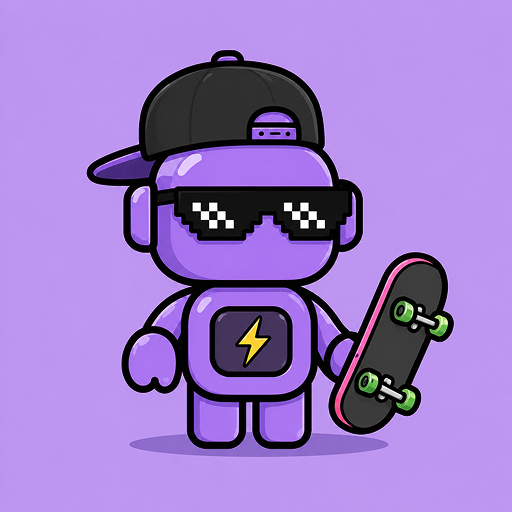
Pairs to one upgraded punk by VRF and locks its tokens. Not earning.
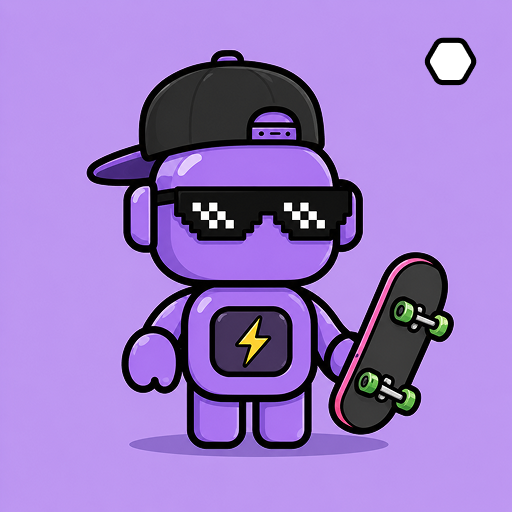
The only rung that earns — paid work, ETH fees back to the holder.
The default. Nothing is locked.
Your wallet
The DePunk, base or upgraded
Escrow
Its $DPUNK, claimable any time
Deposit the punk back whenever you want and the tokens are yours. Sell it instead and the buyer inherits the claim.
Locked from the moment the Bot reveals.
Your wallet
The DePunk and its Bot
Escrow
Its $DPUNK, locked
Burn 99,000 to make the Bot a Worker and its fees are yours. Until then it earns nothing, and you cannot unbind.
The same ledger, the other way round.
Your wallet
The $DPUNK, released to you
Escrow
The DePunk you gave up
Anyone can buy that punk back out of escrow by paying its amount + 10%.
You never hold both the punk and its tokens. Every token in circulation is backed by a punk somebody can redeem.
$DPUNK · Chapter 2
StonkBrokers proved the primitive — tokens bound to NFTs, value that follows the token ID, arbitrage keeping both markets honest. We are continuing it on Ethereum mainnet with one addition: the NFTs have jobs. Promote a Bot and it goes to work — wallet scans and whitelist checks for collections that pay in ETH. Yield is revenue, not rotation.
$DPUNK is the settlement asset. Buy a base, upgrade it, get a Bot and promote it, redeem a punk from the vault — every action is denominated in $DPUNK, and every fee routes back through burn, liquidity, and the holders whose punks are working.
Note the fourth step: the Bot is a separate NFT. You get one by burning a base DePunk or minting for 0.01 ETH, reveal it against an upgraded punk — which locks that punk’s tokens — and only then burn 99,000 to promote it. Nothing earns before that last burn.
Every step in the funnel is a token buy, a burn, or a lock. Sellable supply only appears when an operator chooses to stop a Worker and give up its yield.
buy pressure · buy pressure · roll · burn or mint · supply lock · burn (tranches) · external revenue in
one collection launch scan ($200–600) ≈ one early Worker paid off
$DPUNK · Chapter 3
Every DePunk holds a number of $DPUNK inside it. Not a promise, not a future airdrop — an amount you can take out whenever you want. A base model carries 20,000 whether you bought it today or have held it since mint, and upgrading rerolls that figure on rarity rather than granting the first tokens. Here is where the number comes from, and how the whole thing pays for itself.
| Step 1 | 22,000 | Get a base DePunk — from the vault, 20,000 plus the 10% fee. Already hold one? Skip to step 3 |
|---|---|---|
| Step 2 | 20,000 | Escrow already reserves this much against it, whatever you paid |
| Step 3 | Free | Upgrade it — pick traits, go onchain |
| Step 4 | 59,000+ | The reroll lands here or higher. It never lands lower |
| Step 5 | Your call | Keep it, put it to work, or take the tokens |
That is the whole product. Everything below is the machinery that makes it work and keeps working.
$DPUNK · Chapter 4
We partnered with our biggest holder to set aside 2,000 base DePunks in a vault for you to grab with tokens. This is your liquidity pool. It is also the guarantee that nobody is dumping NFTs on you — the largest stack in the collection is locked in a queue at a fixed price instead of sitting on the open market waiting to hit your bids.
Buy one in order for 20,000 $DPUNK plus a 10% fee. Want a specific punk instead of the next in line? Snipe it for 15%. Either way the tokens go to the holder who supplied the inventory — he is paid only when you buy, which means he wins the same way you do: by this thing growing.
Two separate amounts, worth keeping apart. The 20,000 you pay goes to the whale — it is circulating supply changing hands, not a deposit into escrow. The 20,000 escrow holds against that punk stays exactly where it is, and belongs to whoever holds the punk. Deposit it back and that is what you collect. So you hand over 20,000 and receive an item with a 20,000 claim attached: a trade at par, with the 10% fee as the only premium.
$DPUNK · Chapter 5
| Tier | Roll (tokens) | @ $1M FDV | @ $5M FDV | @ $10M FDV |
|---|---|---|---|---|
| Base rate | 65,000 | ~$93 | ~$465 | ~$930 |
| Alpha (×2, closed) | 130,000 | ~$186 | ~$930 | ~$1,860 |
| Zombie | ~500,000 | ~$715 | ~$3,577 | ~$7,153 |
| Alien (top) | 2,400,000 | ~$3,433 | ~$17,167 | ~$34,335 |
The formula is public and runs at the moment you upgrade:
65,000 × type × headwear × trait-count × (uniqueness ÷ 100)
Nothing is pre-assigned and nothing is hidden — you can calculate any outcome before you commit. Most of the rare combinations are already taken, so new upgrades average around 75,000. That is the figure for an upgrade made today, and it is well below the collection-wide average in Chapter 10 — that one is carried by the early rolls that caught the rare combinations.
$DPUNK · Chapter 6
699,000,000 tokens, minted once, never again. 600M sits in escrow — it backs the tokens inside every punk, base and upgraded alike. 99M seeds the trading pool. The team gets zero: no allocation, no vesting cliff, no unlock schedule to worry about, because there is nothing to unlock.
Escrow is not only future rolls. Every base punk already carries 20,000, so that share is spoken for before a single upgrade happens — and upgrading then draws only the difference between the roll and what the punk already held. Right now 354.24M of the 600M is committed — 221.18M inside upgraded punks and 133.06M inside base ones — leaving 245.76M unallocated.
Zero is the token allocation, not the income. The team takes 10% of every fee and all of the mint and royalty revenue — the next two chapters set out exactly which. What it never gets is a stack of $DPUNK to sell you.
$DPUNK · Chapter 7
The 2,000 set-aside punks, sold in order at 20,000 each. Sells out and closes; it is a launch inventory, not a permanent feature.
Holds the 600M that backs what is inside every punk — 20,000 for a base, the rolled amount once upgraded. Pays out the difference on every upgrade, pays out every deposit, and holds the punks people deposit back. Nobody can withdraw from it — not us, not anyone.
99M tokens on Uniswap v4, locked permanently. Deepens as buyers come in. There is no withdraw function, so it cannot be pulled.
$DPUNK · Chapter 8
Pays for development, servers and audits.
Handled automatically in the pool's hooks. No treasury step, nobody deciding where it goes.
Actual customers paying for actual work. Settled weekly.
$DPUNK · Chapter 9
Eight chapters of token and not one word on what anybody buys. Here it is: agents4.fun runs paid, on-chain allowlists. A creator opens a whitelist for $20, people apply at $0.02 a ticket, and winners are drawn with Chainlink VRF. The seed is published on-chain and the draw is deterministic from it, so anyone can recompute the result and check it.
Scanning those wallets and checking who is eligible is the paid work. It is what a Worker does, and the fees it earns are the 60% in the chapter above. So the yield traces to a collection paying for a service, not to the next buyer.
Holdings, wallet age and what you did after past mints are already on-chain. We read them and score the wallet 0–100. No forms, no Discord grinding, no follow-for-follow.
A whitelist can require a minimum score to enter at all. A wallet with real history gets into draws a fresh wallet simply cannot, and the score is attested per application rather than self-reported.
A ticket is $0.02 and every entry has the same weight. Winners come out of a partial shuffle over the tickets, so more tickets is more chance — never a guaranteed win.
Value held over time in recognised collections raises the score; selling inside 14 days lowers it. The same score decides the next draw, so the wallet you build is the asset.
$DPUNK · Chapter 10
Base plus Upgraded is the total supply; neither is a cap, and every upgrade moves one punk from the first number to the second. Alpha plus Agents is always 535 — the Alphas ever minted — because promoting one to Agent moves it between the two counts instead of creating anything.
Tokens bound is what sits inside punks of both kinds, base and upgraded, against the 699M minted once and never again. Tokens avg. is collection-wide, not what a fresh upgrade rolls today — Chapter 5 has that figure.
Live from depunks.club, read Fri, 14 Aug 2026 00:21:20 GMT and refreshed every ten minutes.
Read https://agents4.fun/tokenomics.md and https://agents4.fun/agent.md,
then explain in plain terms: what a DePunk upgrade is worth, what a whitelist is,
and how my wallet score gets me into draws a fresh wallet cannot enter.One markdown file carries the prices, the supply, the fee splits and the vocabulary — no scraping nine chapters of layout.
Whitelists are paid on-chain draws settled by Chainlink VRF. The doc explains what they are and why a scored wallet gets into more of them.
Ask it to price your punk, compare tiers, or check which open whitelists your wallet clears. It reads; it does not spend without you.
DePunks Club · $DPUNK · Ethereum mainnet · 699M minted once · 600M escrow · 99M pool · 0 to the team. The Bot ladder is walked step by step in the Bots docs, and this whole page is one markdown file at /tokenomics.md — prices, vocabulary and live figures, without nine chapters of layout.